Most business owners apply for a loan the wrong way. They walk into their bank first, get buried in paperwork, or accept the first offer without understanding what it actually costs. This guide changes that. Whether you are borrowing for the first time or refinancing an existing facility, here is everything you need to know — in plain English — before you sign anything.
1. Why Most Business Loan Applications Fail
Rejection is more common than most lenders will admit. According to Federal Reserve data, fewer than half of small businesses that apply for a loan receive the full amount they requested. The reasons are almost always the same:
- Credit score below the lender’s minimum threshold
- Insufficient time in business (most lenders require 12+ months)
- Revenue too low or inconsistent to service the debt
- Applying to the wrong lender type for the business profile
- Incomplete or poorly organised documentation
None of these are unfixable. But you need to know about them before you apply, not after a hard credit pull has already dinged your score.
2. The Five Types of Business Loan — Which One Fits You
Not all business loans work the same way. Using the wrong product for your situation costs you money, time, and sometimes the loan itself.
Working Capital Loan
Short-term funding (3–18 months) designed to cover day-to-day operational costs — payroll, rent, inventory, supplier invoices. Approval is fast, often same-day. Rates are higher because the term is short. Best for: businesses with strong monthly revenue that need a quick cash injection. Compare working capital loan lenders and rates.
Term Loan
A lump sum repaid in fixed monthly instalments over 1–5 years. Predictable cost, lower rates than short-term products. Best for: planned investments with a known ROI — equipment, a new location, a hiring push.
SBA Loan
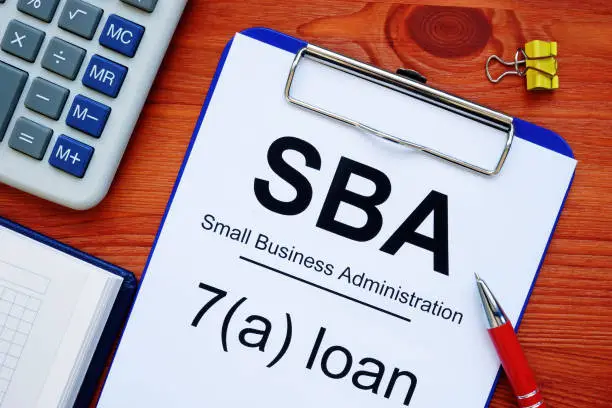
A bank loan backed by the US Small Business Administration, which guarantees up to 85% of the principal. That guarantee unlocks lower rates and longer terms (up to 25 years) than you would qualify for otherwise. Best for: established businesses with solid financials who can wait 30–90 days for approval. See our full SBA loan lender comparison for rates, requirements, and program types.
Business Line of Credit
A revolving credit limit you draw from as needed and repay as you go. You only pay interest on what you draw. Once repaid, funds revolve back. Best for: businesses with unpredictable cash flow who need flexible, on-demand access to capital. Compare business lines of credit here.
Revenue-Based Financing (RBF)
Repayment is tied to a fixed percentage of your daily or weekly sales — not a fixed payment. When revenue drops, so does your repayment. Cost is quoted as a factor rate (e.g. 1.25x) rather than APR. Best for: businesses with strong revenue but limited credit history, or those who want payments that flex with their income.
Invoice Financing
A lender advances up to 90% of your outstanding invoice value immediately, then collects when your customer pays. Approval is based on your customers’ creditworthiness, not yours. Best for: B2B businesses with slow-paying clients and strong receivables.
3. What Every Lender Actually Looks At
Every lender — bank, SBA, online — runs an assessment across four core areas. Knowing what they check, and what their minimums are, tells you exactly which products you are likely to qualify for before you apply.
Credit Score
- Traditional banks: 680+ personal FICO for competitive rates
- SBA loans: 620–680 minimum personal FICO
- Online lenders (OnDeck, Biz2Credit): 560–650 range
- Marketplaces (Lendzi): 500+ accepted, but expect higher rates
- Revenue-based lenders (Fundivi): No credit check — revenue only
Your personal credit score matters even for business loans because most lenders require a personal guarantee, meaning your personal assets are on the line if the business defaults. Read our complete guide on how your credit score affects business loan approval to understand exactly how each tier is assessed.
Time in Business
Most lenders require a minimum of 6–12 months of trading history. SBA loans typically want 2+ years. If your business is under 6 months old, your options are limited to startup-specific lenders, microloans, or business credit cards.
Monthly Revenue
Lenders want to see consistent monthly deposits that comfortably cover repayments. General benchmarks:
- Working capital / RBF: $8,000–$30,000+ per month
- Term loans: $10,000+ per month
- SBA loans: $250,000+ annual revenue typical minimum
- Invoice financing: based on invoice volume, not monthly revenue
Debt-Service Coverage Ratio (DSCR)
DSCR = Net Operating Income ÷ Total Debt Service. A ratio above 1.25 means your business generates 25% more income than it needs to service existing debt — the sweet spot most lenders look for. Below 1.0 means you cannot cover your debt from operations, which is a near-automatic decline.
4. APR vs Factor Rate — The Number That Actually Matters
This is the single most important concept in business borrowing. Two loans with the same stated interest rate can cost thousands of dollars more apart once fees and term length are factored in.
APR (Annual Percentage Rate)
APR expresses the total cost of borrowing as a percentage of the loan amount per year, including fees. It is the only apples-to-apples comparison across different loan products and lenders. A loan with a 12% interest rate and a 3% origination fee has a higher APR than the interest rate alone suggests.
Factor Rate
Used in revenue-based financing and merchant cash advances. A factor rate of 1.25 means you repay $1.25 for every $1.00 borrowed — regardless of how fast you repay. There is no interest compounding. Example: $100,000 at a 1.25 factor rate = $125,000 total repayment, full stop.
Critical rule: never compare a factor rate to an APR directly. Convert first. A 1.25 factor rate on a 12-month repayment term is roughly equivalent to a 50% APR. The same factor rate over 6 months is closer to 100% APR. Speed of repayment changes the effective cost dramatically. Use our free business loan calculator to convert factor rates and compare total repayment costs across offers before you decide.
What to Always Ask a Lender
- What is the full APR including all fees?
- Is there an origination fee? Is it deducted from disbursement?
- Is there a prepayment penalty?
- What is the total repayment amount in dollars?
- Are there any platform, broker, or referral fees?
5. The Five Documents Every Lender Will Ask For
Preparing these before you apply cuts approval time dramatically and signals to lenders that you are an organised, credible borrower.
- Business bank statements (3–6 months): The single most important document for online lenders. Shows real revenue, spending patterns, and cash flow consistency.
- Business tax returns (1–2 years): Required by banks and SBA lenders to verify declared revenue against deposits.
- Profit & Loss statement: A current P&L shows your business’s earning power. Most lenders want to see the last 12 months.
- Business licence / formation documents: Proves your business is legally registered. EIN confirmation, Articles of Incorporation, or LLC Operating Agreement depending on entity type.
- Personal tax return (1–2 years): Required when a personal guarantee is involved, which is most loans.
SBA loans require significantly more documentation — real estate appraisals, business plans, collateral schedules, and sometimes personal financial statements. Online lenders typically need only bank statements and basic business details to issue an approval.
6. Lender Types Compared — Bank vs Online vs Marketplace
Traditional Bank
- Lowest rates: 6–11% APR for qualified borrowers
- Slowest process: 2–8 weeks to funding
- Highest requirements: strong credit, long history, full documentation
- Best for: established, profitable businesses who are not in a hurry
SBA-Approved Lender
- Government-backed rates: 9.75–13.25% variable (based on prime rate)
- Longest terms: up to 25 years for real estate, 10 years for working capital
- Slowest approval: 30–90 days
- Best for: businesses investing in long-term assets who qualify for the program
Online Direct Lender (Fundivi, OnDeck, Biz2Credit)
- Higher rates: 15–99% APR depending on risk profile
- Fastest funding: same day to 72 hours
- Lower requirements: accept 560+ credit scores, 6+ months in business
- Best for: businesses that need capital fast, or those who do not qualify for bank products
Lending Marketplace (Lendio, Lendzi, Fundera)
- One application reaches 60–75+ lenders simultaneously
- Rates vary by the partner lender matched
- Speed: 24 hours to a few days
- Best for: first-time borrowers who want to compare multiple offers without doing multiple applications
7. The Smartest Way to Compare Loan Offers
When you receive multiple offers — and you should always seek at least two or three — compare them on these five factors in order of importance:
- Total repayment amount in dollars. This is the real cost. Add principal + all interest + all fees. The lowest total wins.
- APR. The second-best comparison metric. Accounts for fees and term length. Always ask for this in writing.
- Monthly or weekly payment amount. Can your cash flow comfortably service this without strain? A loan you cannot repay is worse than no loan.
- Funding speed. If timing matters — a supplier deal, a seasonal opportunity — factor in how quickly the capital arrives.
- Lender reputation. Check Trustpilot, BBB, and Google reviews. A lender with hundreds of negative reviews about hidden fees or collections aggression is a risk, regardless of rate. Browse our verified and approved lender list as a starting point.
8. Red Flags — Lenders and Offers to Avoid
The business lending space has legitimate lenders and predatory ones. These are the warning signs that should make you walk away:
- Upfront fees before approval. Legitimate lenders do not charge application or processing fees before issuing an offer. Any request for payment before funding is a red flag.
- Guaranteed approval advertising. No legitimate lender guarantees approval. Anyone who does is either lying or running a fee-based scam.
- Pressure to sign immediately. A real offer does not expire in 24 hours. High-pressure tactics are designed to stop you from comparing alternatives.
- No physical address or verifiable registration. Check that the lender is registered with their state’s financial regulator. Most states require lending licences.
- Factor rates above 1.45. This is roughly equivalent to 100–200% APR depending on term. Not illegal, but worth understanding fully before proceeding.
- Confusing daily debit structures. Some RBF lenders debit your account daily. If the debit amount is not clearly disclosed upfront, ask for it in writing.
9. How to Improve Your Chances Before You Apply
If you are 60–90 days away from needing capital, these steps meaningfully improve both your approval odds and the rate you are offered:
- Separate personal and business finances. If you are running business income through a personal account, open a dedicated business bank account immediately. Lenders assess your business bank statements, not your personal ones.
- Increase average daily balance. Lenders look at average daily balance as a proxy for financial health. Reducing unnecessary outflows for 60 days before applying raises this number.
- Pay down existing credit utilisation. Getting personal credit utilisation below 30% can add 20–40 points to your FICO before the application.
- Dispute any errors on your credit report. Pull your report from Experian, Equifax, and TransUnion. Errors are more common than most people realise and can be disputed and removed within 30 days.
- Build business credit. Get a DUNS number from Dun & Bradstreet. Open a business credit card and pay it in full monthly. Lenders who report to business bureaus (OnDeck, for example) help build your profile with every on-time payment.
10. Step-by-Step: How to Apply the Right Way
- Define your number. How much do you actually need? Overborrowing costs more in interest; underborrowing means a second application. Work backward from the specific use of funds.
- Check your credit score. Use a soft-pull service (Credit Karma, Experian free tier) so you know exactly where you stand before any lender sees you.
- Gather your documents in advance. Bank statements, tax returns, P&L, business licence. Having these ready cuts days off the process.
- Start with marketplaces or soft-pull lenders. Get your range of offers without triggering hard credit inquiries. Fundivi, OnDeck, SoFi, and Lendzi all offer pre-qualification with no hard pull.
- Compare at least three offers on total cost, APR, and monthly payment.
- Only accept one hard pull. Once you have selected the offer you want, accept the full application with that one lender. Multiple hard pulls in a short window signal financial distress to credit bureaus.
- Read the agreement line by line. Look specifically for: prepayment penalties, late fees, personal guarantee clauses, confession of judgment clauses (avoid these entirely), and automatic renewal language.
- Keep records of everything. Funded amount, disbursement date, repayment schedule, lender contact. You will need these for accounting, tax purposes, and if a dispute ever arises.
11. After Funding — What to Do Next
Getting funded is the beginning, not the end. How you manage the loan determines whether it helps or hurts your business.
- Deploy capital for its stated purpose. If you borrowed for inventory, buy inventory. Using loan funds for unrelated purposes creates cash flow problems and potential covenant violations.
- Set up automatic repayments. Missing even one payment triggers late fees and can damage your business credit score. Automate the debit from a dedicated account that always carries sufficient balance.
- Track ROI on the borrowed capital. If you borrowed $50,000 to run a marketing campaign, measure the revenue it generated. Did the return exceed the cost of the loan? If yes, do it again. If no, find out why before the next borrowing cycle.
- Build your credit profile for the next loan. On-time repayment is the single most powerful credit-building tool available. Every payment made on time raises your score and your credibility with lenders for the next application.
12. Frequently Asked Questions
Can I get a business loan with bad credit?
Yes. Online lenders and revenue-based financing providers accept scores as low as 500. Fundivi requires no credit check at all — approval is based entirely on monthly revenue. The trade-off is higher rates. If your credit is below 600, focus on revenue-based or marketplace lenders rather than banks or SBA programs.
How long does it take to get funded?
Online direct lenders: same day to 72 hours. Marketplaces: 24 hours to a few days. Traditional banks: 2–4 weeks. SBA loans: 30–90 days. If you need capital urgently, online direct lenders are the only realistic option.
Will applying hurt my credit score?
Only if the lender runs a hard inquiry. Most online lenders and marketplaces let you check eligibility with a soft pull — zero impact on your score. A hard pull occurs only when you formally accept an offer and proceed to full underwriting. The impact is typically 5–10 points and fades within 12 months.
What is the best business loan for a startup?
Startups under 12 months old have limited options from traditional lenders. The best routes are: SBA Microloan program (up to $50,000, designed for startups), business credit cards for smaller amounts, revenue-based financing if monthly revenue is already above $8,000, and CDFI (Community Development Financial Institution) loans in your local area.
What is a personal guarantee and do I have to sign one?
A personal guarantee is a legal commitment that makes you personally liable for the loan if the business cannot repay. Most lenders require one, including most online lenders. It means your personal assets — savings, home, car — could be at risk in a default. Some lenders offer unsecured loans without a personal guarantee, but these typically carry higher rates to compensate for the reduced security.
Is there a difference between a loan broker and a direct lender?
Yes, and it matters. A direct lender funds the loan themselves (Fundivi, OnDeck, Biz2Credit). A broker or marketplace (Lendio, Fundera, Lendzi) connects you to lenders and may charge a referral or funding fee for the service. Both have advantages. Brokers give you more options with one application. Direct lenders are faster and have cleaner fee structures.
Final Word
The best business loan is not the one with the lowest rate — it is the one that fits your cash flow, your timeline, and your actual use of the capital. A 40% APR working capital loan that funds the same day and generates a 200% return on deployed capital is a better decision than a 7% bank loan you wait six weeks for and miss the opportunity.